Debuting at NADA Miami 2025
Move your mouse or tap to explore
INSTALLATION
KIOSKO
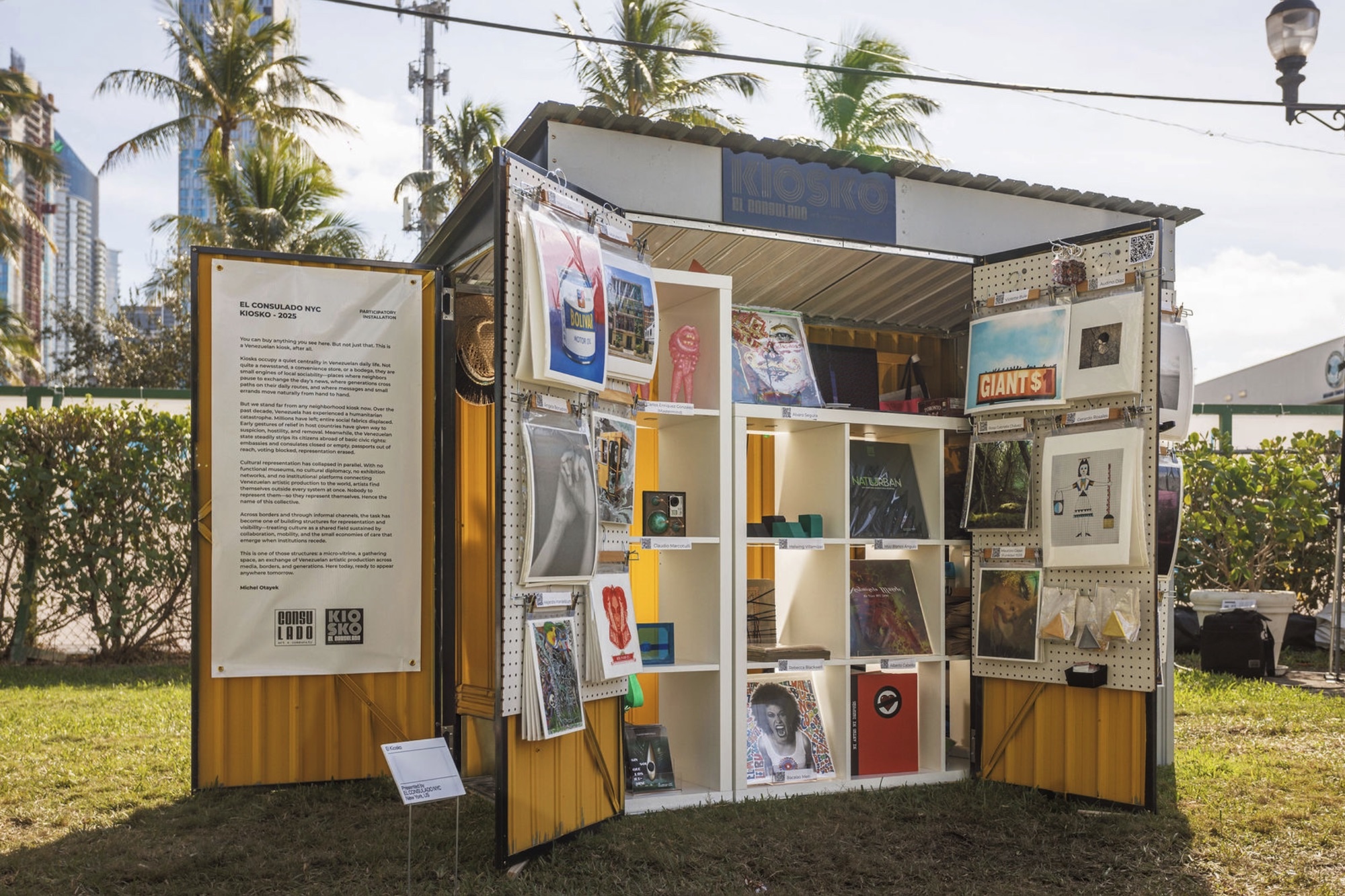
You can buy anything you see here. But not just that. This is a Venezuelan kiosk, after all.
Kiosks occupy a quiet centrality in Venezuelan daily life. Not quite a newsstand, a convenience store, or a bodega, they are small engines of local sociability—places where neighbors pause to exchange the day's news, where generations cross paths on their daily routes, and where messages and small errands move naturally from hand to hand.
But we stand far from any neighborhood kiosk now. Over the past decade, Venezuela has experienced a humanitarian catastrophe. Millions have left; entire social fabrics displaced. Early gestures of relief in host countries have given way to suspicion, hostility, and removal. Meanwhile, the Venezuelan state steadily strips its citizens abroad of basic civic rights: embassies and consulates closed or empty, passports out of reach, voting blocked, representation erased.
Cultural representation has collapsed in parallel. With no functional museums, no cultural diplomacy, no exhibition networks, and no institutional platforms connecting Venezuelan artistic production to the world, artists find themselves outside every system at once. Nobody to represent them—so they represent themselves. Hence the name of this collective.
Across borders and through informal channels, the task has become one of building structures for representation and visibility—treating culture as a shared field sustained by collaboration, mobility, and the small economies of care that emerge when institutions recede.
This is one of those structures: a micro-vitrine, a gathering space, an exchange of Venezuelan artistic production across media, borders, and generations. Here today, ready to appear anywhere tomorrow.
Michel Otayek